
 One of the hardest parts about loving a Pomeranian is learning the difference between normal aging and a health problem that deserves a closer look.
Maybe your little shadow has started emptying the water bowl twice as fast as they used to. Perhaps they’re asking to go outside more often, or their once-plush coat seems a little thinner than it did a year ago. You may even notice that they’re always hungry, even after finishing a meal.
Individually, none of these changes seem especially alarming. It’s easy to tell yourself, “She’s just getting older.”
Sometimes that’s true.
Sometimes it isn’t.
One condition that often develops so gradually that many Pommy parents don’t recognize it at first is Cushing’s Disease. The symptoms tend to appear one by one, quietly becoming part of your dog’s daily routine until one day you realize your Pomeranian simply isn’t quite themselves anymore.
The good news is that a diagnosis of Cushing’s Disease isn’t the end of your Pom’s happy life. With early diagnosis, appropriate treatment, and regular veterinary care, many Pomeranians continue to enjoy years of walks, cuddles, games, and afternoons curled up beside the people they love.
Understanding what’s happening inside your dog’s body is the first step toward helping them feel their best again.
Understanding Cushing’s Disease
Cushing’s Disease, also called hyperadrenocorticism, develops when the body produces too much cortisol over a prolonged period of time.
Cortisol is often called the “stress hormone,” but that description only tells part of the story. In healthy amounts, cortisol helps regulate metabolism, blood sugar, blood pressure, immune function, and the body’s ability to respond to everyday challenges. Your Pomeranian couldn’t live without it.
Like so many things in biology, the problem isn’t the hormone itself. The problem is having too much of it for too long.
Imagine leaving your home’s heating system running at full power every day of the year. At first, everything seems fine. Eventually, though, the constant heat begins wearing down the entire house. Excess cortisol affects the body in much the same way. Over time, it places strain on nearly every organ system, which is why Cushing’s Disease can produce such a wide variety of seemingly unrelated symptoms.
Most cases of Cushing’s Disease fall into one of three categories. The most common—accounting for roughly 80 to 85 percent of cases—is pituitary-dependent Cushing’s Disease, which is caused by a small, usually benign tumor in the pituitary gland. The tumor continually signals the adrenal glands to produce more cortisol than the body actually needs.
Less commonly, the condition begins in one of the adrenal glands themselves. This form, known as adrenal-dependent Cushing’s Disease, is usually caused by a tumor that produces excess cortisol directly.
A third form, called iatrogenic Cushing’s Disease, isn’t caused by a tumor at all. Instead, it develops after prolonged use of corticosteroid medications prescribed to treat conditions such as allergies, autoimmune diseases, or chronic inflammation. Fortunately, this form can often be managed by carefully reducing the medication under veterinary supervision.
Why Pomeranians Are More Susceptible
Although Cushing’s Disease can affect dogs of any breed, veterinarians diagnose it more frequently in small breeds, including Pomeranians.
Part of that increased risk comes with age. Pomeranians are fortunate to enjoy relatively long lifespans, which means they’re more likely to reach the years when hormonal disorders become more common. Genetics also appear to play a role, although researchers are still working to understand exactly why some dogs develop the disease while others never do.
Being a Pomeranian doesn’t mean your dog will develop Cushing’s Disease.
It simply means it’s one of the conditions worth keeping on your radar as your Pom enters their senior years.
The Signs Often Begin Quietly
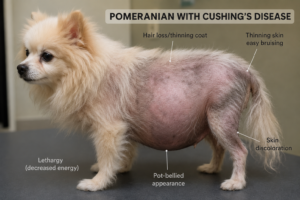 One of the reasons Cushing’s Disease can be difficult to recognize is that it rarely announces itself all at once. Instead, the symptoms usually appear gradually over months, sometimes even years.
Many Pommy parents first notice that their dog seems unusually thirsty. The water bowl needs refilling more often, and bathroom breaks become increasingly frequent. Others notice that their dog suddenly seems hungry all the time or begins begging for food despite eating regular meals.
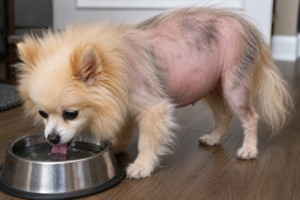
Changes in the coat are also common. That thick, fluffy Pomeranian coat may begin thinning, especially along the body, while the skin underneath becomes more delicate and prone to irritation.
As the disease progresses, some dogs develop the classic “pot-bellied” appearance caused by muscle weakness and changes in fat distribution. They may tire more easily on walks, hesitate before jumping onto the couch, or spend more time resting than playing. Excessive panting, even in comfortable temperatures, is another symptom many parents notice.
None of these changes automatically mean your Pomeranian has Cushing’s Disease. Many other medical conditions can produce similar symptoms. But if several begin appearing together, it’s a good reason to schedule a visit with your veterinarian and have the conversation sooner rather than later.
Related Posts:
Pomeranian Health: How to Keep Your Pom Healthy
Pomeranian Skin Issues and Diseases
Black Skin Disease in Pomeranians